We can't find the internet
Attempting to reconnect
Something went wrong!
Hang in there while we get back on track
Nx
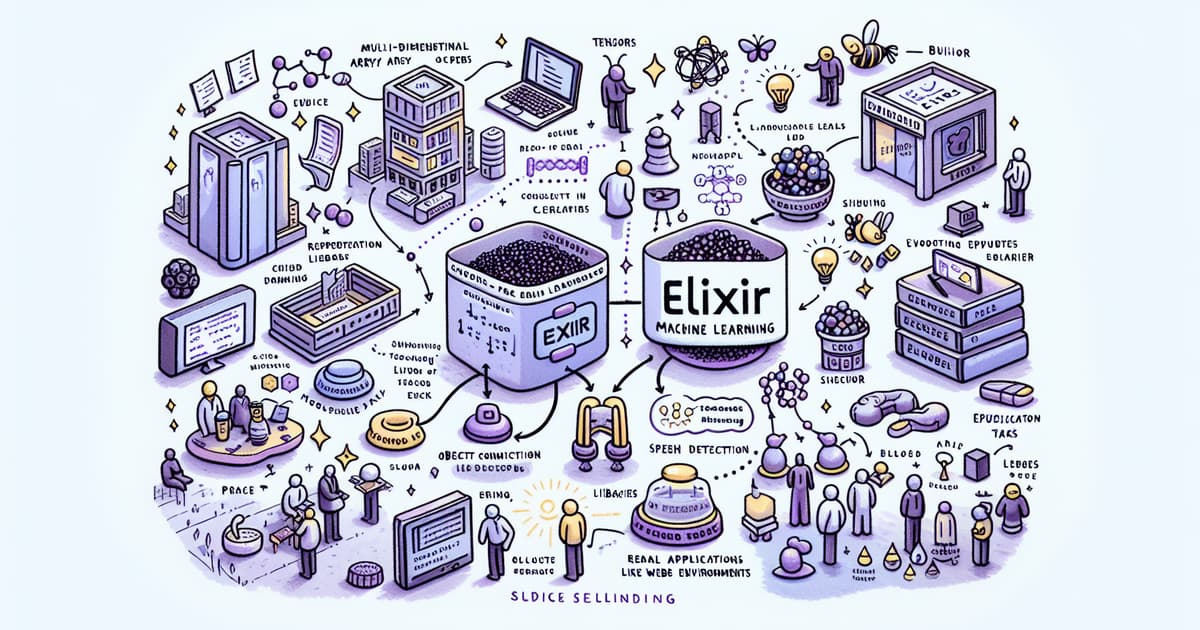
Elixir has steadily grown to become a viable and efficient language for machine learning, with an expanding ecosystem of libraries and tools. Nx, short for Numerical Elixir, is at the forefront of this surge, serving as a foundation for multidimensional array operations and facilitating machine learning tasks. Tensors, core units of data in Nx, can perform a wide range of mathematical computations essential for machine learning, including algorithms for both deep and traditional learning models.
Contributions by individuals such as Andres C Alejos and Sean Moriarity have significantly enriched the Elixir landscape with libraries like Bumblebee and Scholar. These tools provide capabilities comparable to their Python counterparts, allowing for tasks such as object detection and speech recognition. Furthermore, the intersection of Elixir's concurrent programming features with machine learning has presented intriguing possibilities for real-time applications in web environments, as highlighted by Philip Brown's work with Phoenix and LiveView.
Sean Moriarity's exploration into large-language models and open-source alternatives have underscored Elixir's expanding range and its potential for bespoke, cost-effective solutions. The language's evolution has been marked by key conferences like ElixirConf where practitioners share insights into machine learning applications such as spam detection, object detection, and production-model serving using Elixir-based solutions. Workshops and books dedicated to machine learning in Elixir, such as those by Sean Moriarity, demonstrate a growing interest in educational resources to bolster the community's expertise. Finally, the involvement of Elixir's creator, José Valim, and core team members in discussing future directions, underlines the community's commitment to advancing the language in harmony with machine learning.

Elixir and Open-Source Alternatives to Proprietary LLMs like ChatGPT
In this blog post by Sean Moriarity, he discusses the rise of large-language models (LLMs) like OpenAI's ChatGPT and GPT-4, and explores open-source alternatives to these models. He highlights the benefits of using open-source models, such as data privacy, lower latency, task-specific performance, and cost considerations, and introduces some popular open-source options like Flan-T5, Llama, and OpenAssistant that can be used with Elixir.

Building a Video Object Detection Prototype with Elixir
Philip Brown has built a prototype of object detection in a video stream using Elixir, Bumblebee, and Phoenix LiveView. He provides a step-by-step guide on setting up the project, implementing object detection from a video, and building the LiveView application for displaying the video and predictions in the browser.

Tutorial on Recognizing Handwritten Digits with Elixir ML
In this tutorial by Philip Brown, you will learn how to build an end-to-end machine learning project using Elixir. The tutorial covers everything from setting up the project using Phoenix, obtaining training data, preprocessing the data, building and training the model, and finally, creating a LiveView to accept user input and display predictions.
Exploring Nx and Tensors Beyond Machine Learning in Elixir
This post by Jason Stiebs explores the use of NX with Elixir for efficient math programming. It explains how tensors can be used to perform various mathematical operations and highlights the potential of NX for tasks like machine learning and image manipulation.

From Python to Elixir Machine Learning
Andres C Alejos discusses the growth of Elixir's machine learning ecosystem and why now is a good time to start porting machine learning code into Elixir. He provides practical tips and examples for developers looking to move from Python to Elixir for machine learning projects.

Insights into Elixir's Machine Learning Libraries
Andres C Alejos provides an introduction to machine learning in Elixir and offers a glossary of libraries in the Elixir machine learning ecosystem. He covers libraries such as Elixir-Nx, Axon, Bumblebee, Scholar, Explorer, Scidata, EXGBoost, Ortex, Livebook, and more, highlighting their functionalities and similarities to popular Python libraries.
© HashMerge 2026